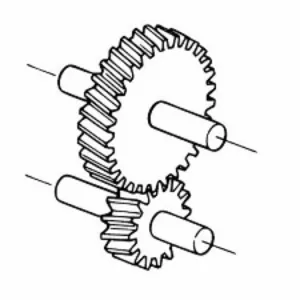
Helical gears
Looking for durable, reliable and affordable gearing?
HELICALGEARS
Helical gear design
Helical gears are selected for their remarkable ability to minimize friction, heat and noise compared to other gear types. Their distinctive feature lies in their special profiles, which comprise a series of inclined cuts along the edge of the gear. Each tooth of these gears is meticulously designed to mesh harmoniously with those of the opposite helical gear, which rotates in the opposite direction.
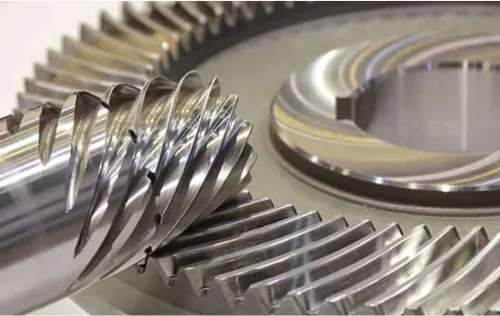
Compared to other gear configurations, helical gears offer a smoother, more progressive operating experience. This smoothness is the result of the fluid interaction between their teeth and the axis of rotation, which can be either fixed parallel or inclined at a 90-degree angle.
Compared to other gear configurations, helical gears offer a smoother, more progressive operating experience. This smoothness is the result of the fluid interaction between their teeth and the axis of rotation, which can be either fixed parallel or inclined at a 90-degree angle.
Advantages of helical gears
- Ideal for high loads thanks to their increased number of teeth in contact during rotation.
- Versatile: can transfer motion and power on parallel or right-angle axes.
- Durable: evenly distribute the load over the axes, reducing wear over time.
- Quiet, stable operation thanks to the progressive meshing of their inclined teeth.
Disadvantages of helical gears
Helical gears can generate additional parasitic forces due to their helix angle, such as axial forces on shaft bearings and increased shaft bending torques, which can lead to a slight reduction in efficiency. As a result, they cannot be used in applications where disengagement is required, such as certain gearboxes; they must always be engaged.
Fields of application
Because of their smooth operation and low noise level, even at high speeds, helical gears are widely used in the automotive and manufacturing industries. They are also suitable for applications requiring spur gears but with non-parallel shafts.
Characteristics of helical gears
Teeth are twisted at an angle to the gear axis.
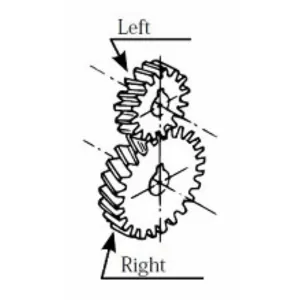
Propeller direction (propeller hand) :
The propeller hand is designated as either left-hand or right-hand.
Left and right helical gears are coupled as a unit. But they must have the same helix angle
Features:
- Higher resistance than spur gears
- More effective at reducing noise and vibration than spur gears
- Geared gears produce thrust forces in the axial direction
- Applications :
- Transmission components, automotive, speed reducers, etc.