


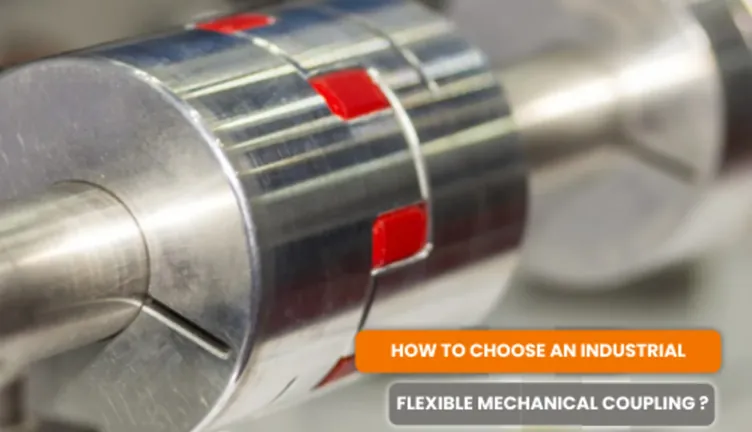
The choice of an industrial flexible mechanical coupling is an important step in the design or maintenance of a transmission system.This component connects two rotating shafts to transmit torque while absorbing vibrations, shocks, and minor misalignments. An improperly sized coupling can lead to excessive vibration, accelerate bearing wear, and ultimately cause production downtime. Conversely, a correctly selected model helps ensure stable and long-lasting transmission operation. At ITAFRAN, a wide range of flexible mechanical couplings is available from stock at our Lyon logistics platform to quickly meet the needs of industrial customers.

Why choose a flexible mechanical coupling rather than a rigid one?
In most industrial installations, maintaining perfect shaft alignment over time is difficult due to thermal expansion, frame deformation, and vibrations during operation. This is why...flexible mechanical couplingIt has established itself as the benchmark solution in sectors as diverse as food processing, maritime, rail, and cement manufacturing. Unlike rigid couplings—which require perfect alignment and tolerate no angular, radial, or axial misalignment—the flexible model incorporates an elastic element (elastomer, rubber, or polyurethane) that acts as a shock absorber between the two coupling halves. The result: an extended lifespan for the entire drivetrain and a significant reduction in production downtime.
Key advantages of flexible coupling
- Absorption of misalignments : angular, radial and axial up to values defined by the manufacturer.
- Vibration damping : protection of bearings, gearboxes and other sensitive components.
- Overload protection : The elastic element acts as a mechanical fuse in case of impact.
- Maintenance-free : Most flexible models require neither greasing nor lubrication.
The different types of flexible mechanical couplings at ITAFRAN
ITAFRAN offers several models of flexible mechanical couplings, each adapted to specific constraints of torque, speed and environment:
HRC couplings
THE HRC type elastic couplingsThese are among the most robust on the market. Their machined diameter facilitates alignment during assembly, and their installation requires only a simple straightedge. They offer high heat resistance and are suitable for most common industrial applications: pumps, fans, compressors, and conveyors.
ACPG semi-elastic couplings
Composed of two machined steel hubs and a star-shaped elastomer, ACPG couplings offer excellent vibration damping. They require no maintenance and operate between -35°C and +80°C. Their compact design makes them particularly suitable for installations with difficult access.
Fenaflex couplings
Of the pneumatic type and requiring no lubrication, Fenaflex couplings tolerate large amounts of misalignment in all planes. They effectively absorb shocks and torsional oscillations. Available in a FRAS (fire-resistant and antistatic) version, they are recommended for demanding environments such as marine, mining, and oil and gas.
How to choose your flexible mechanical coupling: the essential criteria
The choice of a flexible mechanical couplingIt relies on several technical parameters that must be analyzed before placing any order. Among the main criteria to analyze are:
- Nominal torque and peak torque : They determine the transmission capacity of the coupling. Always allow for a service factor appropriate to your application.
- The rotation speed : Expressed in rpm, it determines the maximum permissible peripheral speed and the dynamic dimensioning.
- The type and degree of misalignment : Accurately measure angular, radial, and axial misalignments to select the model that absorbs them.
- Environmental conditions : operating temperature, humidity, presence of oil, chemicals or explosive atmospheres.
- Maintenance constraints : For hard-to-reach installations, choose maintenance-free models (ACPG, Fenaflex).
Industrial applications of flexible mechanical couplings
Flexible mechanical couplings are used in many industrial sectors:
- Agri-food : Maintenance-free models, resistant to frequent washing, compliant with hygiene standards.
- Maritime et offshore : Fenaflex FRAS fire resistant and antistatic.
- Rail and transport : Flexible couplings for shock and vibration absorption.
- Mining and cement industry : robust models with high torque capacity.
- Machine tools and automation : transmission accuracy and pin protection.
- Energy and environment : pumps, compressors, generators and turbines.
FAQ — Frequently asked questions about flexible mechanical couplings
What is the difference between a rigid coupling and a flexible coupling ?
The rigid coupling transmits torque without any flexible elements: it requires perfect shaft alignment and tolerates no misalignment. The flexible coupling incorporates an elastomer that absorbs misalignment, vibration, and shock, making it far more versatile in real-world industrial applications.
How do you know when to replace the flexible element of a coupling ?
Signs of wear to watch for include: abnormal vibrations during operation, clicking or creaking noises, and visible deformation or cracking of the elastomer. In most cases, only the flexible element needs to be replaced, without dismantling the shafts—significantly reducing machine downtime.
Which coupling should be chosen for an agri-food application ?
For food processing applications, choose maintenance-free couplings such as ACPG or Fenaflex models. They require no greasing or lubrication, withstand frequent washing, and do not risk contaminating products. Also, verify that the materials comply with the hygiene standards in force in your sector.
A specific project or a technical question ? Contact our product experts for a personalized quote.
For any technical questions or for a specific project, our team remains available to guide you towards the most suitable solution for your application.