


Choose your linear guide!

Are you looking for the right pulley for your application?
Pulleys are ubiquitous components that can be found in many applications, from construction equipment to sewing machines. So it's not surprising that there's a wide variety of pulley styles and types available on the market.
_cropped_250_280.webp)
Are you looking for the right pulley for your application?
Pulleys are ubiquitous components that can be found in many applications, from construction equipment to sewing machines. So it's not surprising that there's a wide variety of pulley styles and types available on the market.
What types of linear guides are there?
There are 3 main categories of linear guides:
- Standard linear guides represented by the NH / NS series
- Wide linear guides for single guidance represented by the LW series
- Miniature linear guidance represented by PU / PE series


What arethe Special Features of NSK Linear Guides? NSK LINEAR GUIDES?
Resistance to impact load
The lower ball groove is Gothic-arched, as are the centers of the upper and lower grooves, with the center of the lower groove offset, as shown in Fig. 2. The vertical load is generally borne by the upper ball rows, where the balls are in contact with the ground.
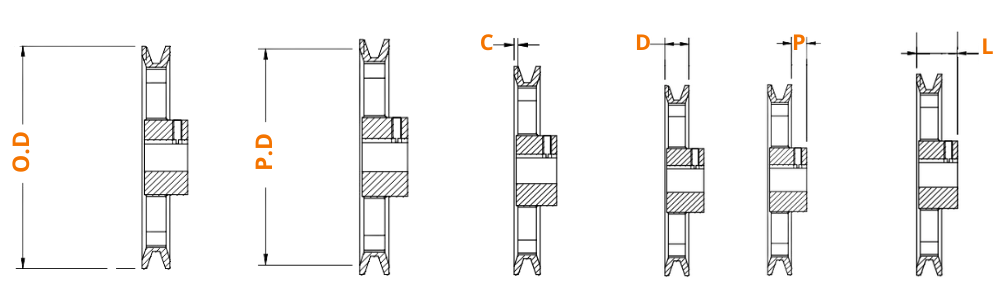
First, measure the outside diameter (OD) of the pulley.
- Step 2: Next, measure the pitch diameter (PD). This is the measurement that represents the diameter of the belt itself as it runs over the pulley. This step is not necessary if you already know the size of your V-belt, or if the pulley and belt are badly worn.
- Step 3: Measure the pulley wall thickness.
- Step 4: Measure the total width of the belt housing, where the belt actually passes through the pulley.
- Step 5: If the pulley has a hub that exceeds the width of the "belt case", it's generally recommended to measure the hub extension.
- Step 6: The final measurement is the overall width of the pulley. In most cases, this will designate the belt type or series used.
How do I measure V-belt pulleys?
Learning to measure the size of a V-belt pulley and calculating its dimensions are simple tasks; however, correctly identifying a type of V-belt pulley can be a complex process.
Identifying the right pulley
Identifying a pulley involves determining several important characteristics of the pulley, including its size, type, diameter, groove (if it has one), and load capacity. Here are the general steps for identifying a pulley:
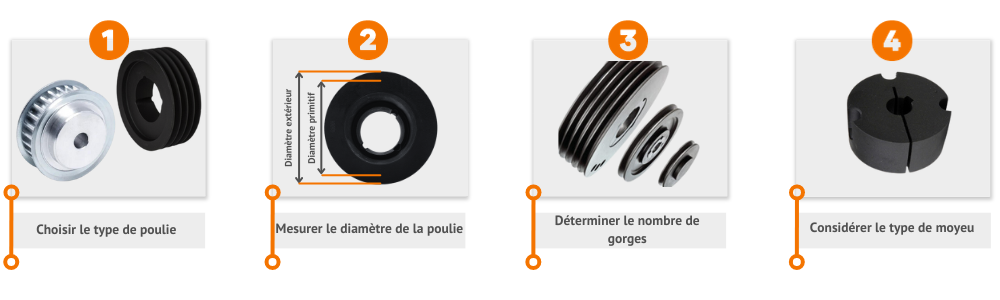
- Determining the type of pulley: There are several types of pulley, including V-groove, flat-groove, round-groove, geared and others. First, identify the type of pulley you have.
The easiest way to identify a V-belt pulley is to find the part number or identification components on the pulley itself
on the pulley itself. Different brands, and different types of pulley, have different ways of displaying these numbers.
- Probably the most common style for medium and small pulleys is for the number to be stamped on the pulley before it is painted or phosphated
or phosphated. This can make it difficult to identify the numbers and letters in most cases.
- Another style is where the part number is in the casting itself.
- Another style is to place different identification characters on different spokes.
_cropped_500_300.webp)
If your part number is indistinguishable, follow steps 1 to 6 above to measure the pulley. Then distinguish the style of pulley you have based on the photos below. Note: If you have a fixed-bore pulley, please indicate the inside diameter of the bore. Finally, we'll need to know how many grooves are in your pulley, this along with the overall width will confirm the type of belt you're using.
- Measure pulley diameter: Use a caliper or tape measure to measure the pulley diameter. Measure from one side of the groove to the other for grooved pulleys, or from edge to edge for flat pulleys.
- Measure groove width (if applicable): If the pulley has a groove (for example, a V-groove pulley for a belt), measure the width of the groove. This can be important in selecting the right belt.
- Determine the number of grooves (if applicable): If you have a grooved pulley, count the number of grooves. This may be important in choosing the right belt.
- Check hub type: The pulley hub may be fixed, removable or flanged. Check the type of hub you have.
- Check load capacity: If relevant to your application, consult the manufacturer's specifications for the maximum load capacity of the pulley. Make sure it's suitable for your application.
- Look for marks or model numbers: Often, pulleys will have marks or model numbers engraved or printed on them. Make a note of this information, as it can help you identify the pulley more accurately by searching online or contacting the manufacturer.
By following these steps, you should be able to identify the pulley you need for your application. Be sure to take accurate measurements and gather all relevant information to ensure a proper match with other components in your system.
Linear guidance glossary
Self-Alignment
Thanks to its internal structure X-shaped raceways with a contact angle of 50% (unique on the market), the linear guide will accept and compensate for imperfections in the support for optimum operation.
(1)_cropped_800_300.webp)
Self-Alignment
Thanks to its internal structure X-shaped raceways with a contact angle of 50% (unique on the market), the linear guide will accept and compensate for imperfections in the support for optimum operation.
Pulley bending
It is determined by two values, Ca static and C dynamic, which characterize the maximum level acceptable by the skid. Please note that they can be specified in accordance with ISO/DIN and New DIN standards.
rotation power
The ability of a pulley to transmit mechanical power from one point to another by rotating a load. This power is expressed in watts (W) or horsepower (HP) in the international system of units. Rotational power depends on a number of factors, including the torque (rotary force) applied to the pulley, the speed of rotation (in revolutions per minute or radians per second), and the efficiency of the transmission system, including the belt used.
Rotational power is calculated using the following formula:
P=τ⋅ωP=τ⋅ω
where:
- PP is power in watts (W) or horsepower (HP).
- ττ represents torque in newton-meters (N-m) or pound-feet (lb-ft).
- ωω is rotation speed in radians per second (rad/s) or revolutions per minute (rpm).
PLEASE NOTE:
You need to choose the right hub to couple your pulley to the shaft in question. To do this, refer to the "How to choose a removable hub" guide
Note: in a mechanical pulley/belt connection, the speed is unchanged when both pulleys have the same pitch diameter. Therefore, to change speed, the pulleys must have different pitch diameters. In such cases, the reduction ratio R is calculated and used to determine the output speed (R < à 1 = réduction de vitesse et R > to 1 = speed increase).
By following these tips, you should be able to choose the belts that are best suited to your application, and that operate safely and efficiently.
If you have any questions or comments on this definition, please use this form. Thank you in advance!
Get your free copy of the complete pulley guide!
FAQ
Here are some of the most frequently asked questions about linear guides!
What is a linear guide?
The linear guide is a device consisting of a guide rail and one or more guide shoes, which enables objects or loads to be moved longitudinally (translational movements).
It is one of the most important components in machine tools. NSK's linear guides offer numerous advantages, including
- Extremely precise positioning: up to 2µm for a stroke of 100 mm
- Translation of the lightest to the heaviest loads
- Allows slow to high speeds (up to 10 m/s)
- Can be finger-jointed to increase guide length
To identify your prismatic rail, you need to take into account ..:
- dimensionsthe prismatic rail is standardized under ISO 12090, making it easy to compare different manufacturers
- Materialwe offer guideways in high-carbon steel and stainless steel.
- Treatmentswe offer guideways with black oxide surface treatment. Nitriding and anti-corrosion treatments are also available on request.
To assist you in your selection, we have provided a configuration tool enabling you to select the various criteria for your linear guide. Our sales department can also assist you with special requests.
How to choose a linear guide?
When selecting a linear guideway, it is important to take several factors into account, including :
- Functional factors related to machine use: it's important to determine the motion configuration, overall dimensions, rigidity, load capacity and positioning accuracy of the linear guide in relation to the machine installed.
- Environmental factors related to your activity: take into account the externalities specific to your activity and the use of the machine in terms of dust, pollution and extreme temperatures.
- Cost factors cost factors: standardized products / calculate the cost of assembly, maintenance and the energy required for operation.
By taking these factors into account, you'll be able to determine which series of rails to use, as well as the associated pads for a specific load and assembly. Our sales department can provide you with installation recommendations in conjunction with our partner NSK.
What is a linear guide?
Toothed pulleys help transmit force more precisely, operate synchronously and withstand high loads better than trapezoidal pulleys.
They are preferred in applications requiring greater precision and reliability.
What is a linear guide?
3 elements must be known to calculate the pulley diameter:
- pulley diameter
- Rotation speed (in revolutions per minute)
- Linear distance the pulley has to cover ( example: the circumference of the driven belt)
Use the formula: Circumference (in millimeters) = π x Diameter (in millimeters).
Number of teeth = Linear distance per revolution / Distance moved by each tooth.
Round off the final result, as pulleys generally have a whole number of teeth
The number of teeth can also be calculated by multiplying the number of teeth on the belt by the belt pitch. For example, an 8mm belt with 60 teeth has a pitch length of 480mm (60 teeth x 8mm pitch = 480mm).
What is a linear guide?
Flanges are the lateral parts that surround the pulley groove. They are designed primarily to hold the belt in place. In addition to this, they provide other significant advantages, such as :
- Belt guidance and stability
- Protection from external damage
- Reduced bending and flexing of the belt
- Maintenance of lubrication in certain cases
What is a linear guide?
Toothed pulleys help transmit force more precisely, operate synchronously and withstand high loads better than trapezoidal pulleys.
They are preferred in applications requiring greater precision and reliability.
What is a linear guide?
Toothed pulleys help transmit force more precisely, operate synchronously and withstand high loads better than trapezoidal pulleys.
They are preferred in applications requiring greater precision and reliability.